Introduction: the unseen risk in global brand expansion
As brands scale across markets and languages, the logical control point for safeguarding digital presence shifts from a single brand site to a sprawling domain portfolio that spans continents, TLDs, and brand-adjacent entities. The problem isn’t merely a missing registration or an expired certificate; it’s the invisible layer of risk that travels with every new country footprint, every new product line, and every partnership that leverages a branded web address. In practice, enterprises face two intertwined challenges: first, identifying where exposure exists within a sprawling domain estate, and second, turning that knowledge into a governance-ready action plan that teams across legal, security, and marketing can execute. This article introduces a quantitative approach—domain exposure heatmaps—that makes risk visible, comparable, and manageable at scale. It also shows how to translate heatmaps into concrete portfolio governance, supported by domain documentation and a pragmatic vendor framework.
The rationale is simple: protecting digital assets requires more than reactionary blocking or compliance checklists. It requires a living map of where risk clusters live, why they exist, and how to remediate them in a way that aligns with business priorities. For readers navigating this terrain, we’ll draw on practical sources from industry bodies and practitioners while highlighting a model that BPDomain LLC can operationalize through domain documentation and governance services.
Note on data realities: GDPR and other privacy regimes have reshaped how ownership and contact information are surfaced for domains. Public WHOIS data has become more restricted in many jurisdictions, prompting reliance on RDAP lookups, escrow records, registrar APIs, and other corroborating signals to verify asset provenance. Industry voices emphasize careful due-diligence in this new privacy-first era, especially when assessing asset ownership and transfer risks. (dn.org)
What is a Domain Exposure Heatmap?
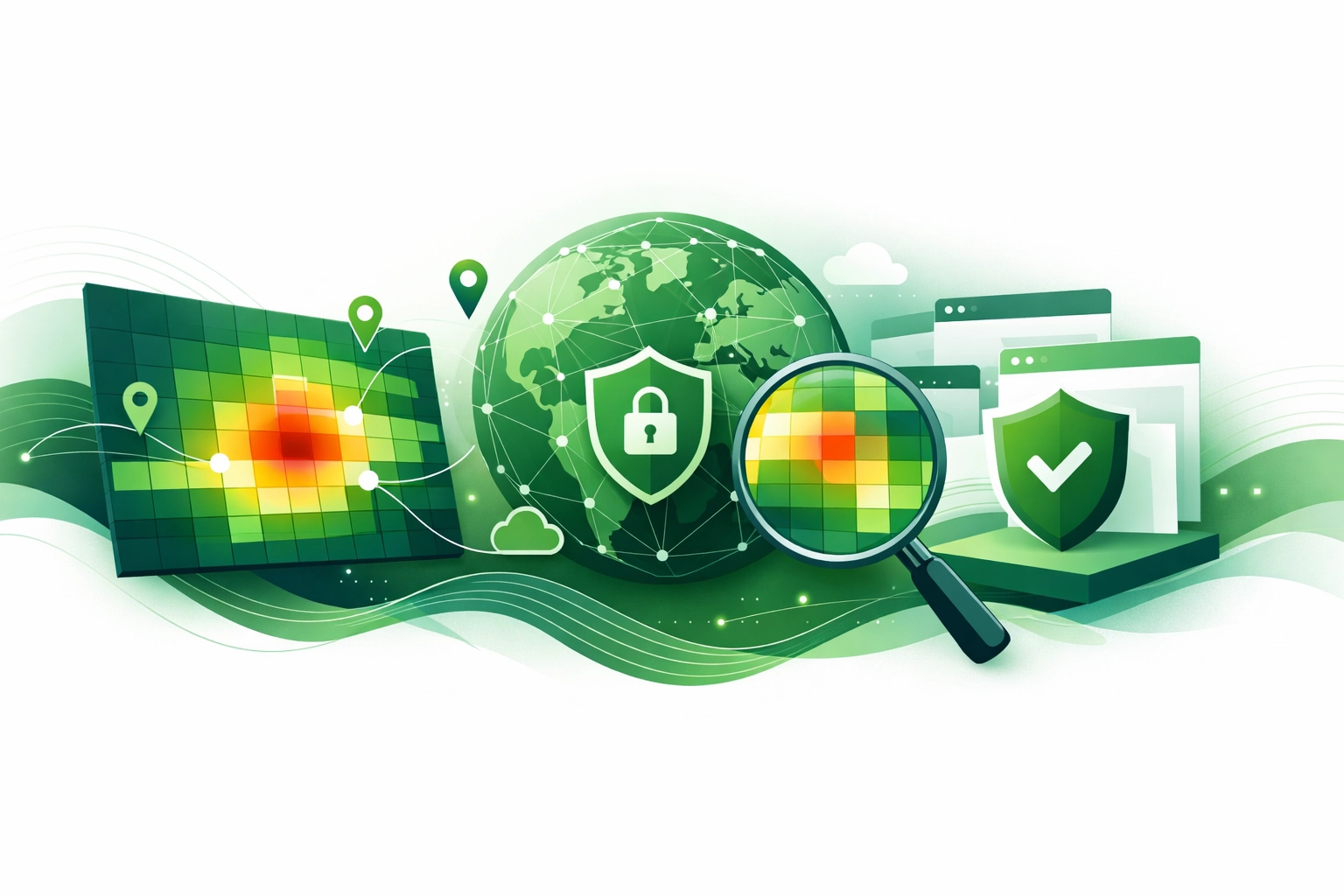
A domain exposure heatmap is a color-coded, multi-criteria map that visualizes risk across a portfolio of domain assets. Instead of a flat inventory, it layers signals such as ownership verifiability, brand-aligned keyword risk, homoglyph exposure (lookalikes), geographic footprint, and security health (TLS/SSL status, DNS health, certificate coverage). The objective is to provide decision-makers with a single view that prioritizes remediation actions based on potential business impact and remediation cost. In short, heatmaps translate data into prioritization and policy—an essential capability for enterprise-scale brand security and domain strategy.
Why heatmaps, not lists? A long inventory of domains without context yields nested blind spots. Heatmaps force trade-offs: a region with many lookalikes may require faster remediation (even if each individual domain carries modest risk) because the aggregate exposure could drive brand damage, customer confusion, or regulatory risk. This approach supports portfolio governance by aligning domain strategy with business objectives and resourcing constraints.
From a practical standpoint, heatmaps integrate several data streams: ownership signals (who can prove ownership amid privacy controls), brand signal (how closely a domain aligns with the registered brand and product lines), security health (SSL/TLS posture, DNSSEC status, certificate validity), and operational signals (renewal cadence, registrar reliability, transfer risk). These pieces create a composite risk score that is interpretable by executives and actionable by operations.
Expert insight: analysts from respected trade associations stress that ownership verification in a GDPR-impacted ecosystem requires combining multiple data signals—public records, private registrant data (via sanctioned channels), and escrow or registry-level attestations—to establish asset provenance. This is exactly the kind of due-diligence framework that can be codified into heatmaps and governance policies. (inta.org)
A pragmatic 5-step heatmap framework for enterprise domain security
Below is a concise, repeatable framework to convert heatmaps from concept to action. It is designed to scale across hundreds or thousands of domains and to align with cross-functional governance processes. Each step includes practical considerations, typical metrics, and concrete deliverables that teams can produce on a quarterly or biannual cycle.
-
Step 1 — Define coverage and risk criteria
- Clearly specify which brands, products, and markets are in scope; determine whether you include lookalikes, homoglyphs, and region-specific TLDs
- Define risk dimensions (ownership verifiability, brand alignment, security health, renewal risk, and incident history)
- Agree on scoring thresholds (e.g., critical, high, medium, low) and escalation paths
-
Step 2 — Build a living inventory with provenance signals
- Consolidate registrations, registrations under affiliates, and partner domains that carry brand risk
- Capture provenance signals beyond public WHOIS (RDAP, registrar escrow records, brand ownership proofs)
- Assign a primary owner for every domain (with cross-checks for privacy-protected records)
-
Step 3 — Layer risk signals for heatmap construction
- Ownership verifiability score (0–10) based on accessible evidence; note where privacy tools obscure proof
- Brand alignment score (0–10) considering product naming, logo usage, and trademark gaps
- Security health score (0–10) derived from certificate status, DNS health, and TLS coverage
- Geographic and regulatory risk score (0–10) reflecting local data/privacy regimes and cross-border implications
-
Step 4 — visualize and prioritize remediation
- Translate scores into a color-coded map (e.g., red for critical, amber for high, green for safe)
- Prioritize domain remediation by business impact, not just risk score; plan quick wins (redirects, private registrations, or takedowns) alongside strategic moves (portfolio reallocation, consolidation, or new acquisitions)
- Document remediation actions and owners; track implementation and outcomes
-
Step 5 — institutionalize domain documentation for governance
- Embed heatmap outputs into formal domain documentation assets, creating an auditable trail for compliance and M&A due-diligence
- Align with portfolio governance policies and annual budgeting cycles; ensure accessibility to security, legal, and marketing leaders
- Review and refresh the heatmap cadence, thresholds, and data sources periodically
Deliverables you should expect from a disciplined heatmap program include a quarterly heatmap report, an updated domain inventory with provenance signals, and a governance brief outlining prioritized remediation actions and owners. This is where a domain documentation-centric approach—an area where BPDomain LLC clients often see meaningful value—meets practical risk management. BPDomain LLC Pricing reflects how this discipline translates into measurable service options.
Where heatmaps intersect with domain documentation
Domain documentation acts as the backbone of governance by converting heatmap insights into repeatable, auditable records. A robust documentation framework captures: domain ownership evidence, renewal calendars, security posture artifacts, incident history, and remediation decisions. When heatmaps point to high-risk domains, documentation outlines the rationale for remediation, the steps taken, and the expected business outcomes. In practice, this documentation serves multiple stakeholders: legal teams evaluating brand risk in mergers and acquisitions; security teams prioritizing remediation focus; and marketing teams aligning brand strategy with cross-border expansion. As one industry report notes, due diligence in a privacy-conscious era increasingly relies on corroborating signals beyond bare WHOIS data, underscoring the need for comprehensive domain documentation. (inta.org)
Practical data sources and governance workflows
A heatmap program should leverage a compact set of trusted signals, with clear ownership and governance workflows. The following sources and practices help anchor a defensible heatmap framework:
- Ownership and provenance signals: RDAP lookups, registrar escrow attestations, and cross-verified ownership proofs help compensate for GDPR-driven redactions in public WHOIS. This multi-signal approach aligns with the ongoing industry dialogue about responsible data access and verification. (cio.com)
- Brand alignment and risk signals: mapping each domain against brand taxonomy, product lines, and trademark coverage helps quantify “brand fit” alongside technical risk. This dual lens is essential for prioritizing resource allocation across a sprawling portfolio.
- Security health signals: TLS/certificate health, DNSSEC status, and certificate validity are concrete indicators of a domain’s operational risk and resilience against abuse. Industry observations show attackers increasingly exploit weak or misconfigured domains, reinforcing the need for continuous health monitoring. (billhartzer.com)
- Geographic and regulatory signals: regional privacy frameworks and local data handling rules affect how domains are managed, renewed, and remediated in different markets. This underpins the argument for a cross-border domain strategy that centralizes governance while respecting local constraints. (dn.org)
In practice, a heatmap-informed program benefits from a centralized data hub that aggregates RDAP, registry data, security signals, and brand metadata. The hub then outputs action-ready dashboards and domain documentation packs that teams can fetch in their existing workflows (for example, via BPDomain LLC’s domain governance services).
Expert insights and common limitations
An informed expert perspective emphasizes the need to balance transparency with privacy in the modern domain landscape. As the INTA’s WHOIS Temp Spec report explains, verification of domain ownership in GDPR-inflected environments requires careful policy design and the strategic use of trusted data sources, since public visibility is constrained by privacy rules. This reinforces why a heatmap approach—relying on multiple corroborating signals—tends to be more robust than any single data source. (inta.org)
From a practitioner’s vantage, one compelling limitation is the imperfect visibility of ownership signals in privacy-protected records. A heatmap that depends too heavily on redacted data risks misclassifying risk or overlooking risk that lies in the unknown. The antidote is a disciplined risk framework that uses probability-based scoring, transparent escalation thresholds, and documented remediation plans, plus ongoing validation with verifiable signals (escrows, registrars, and brand documentation). This is precisely the ethos BPDomain LLC brings to market through domain documentation and governance services.
Another practical constraint is the ever-present risk of typosquatting and lookalikes, which remain a persistent vector for brand abuse. Modern analyses show that the domain space remains dynamic, with new registrations and evolving tactics posing ongoing threats to brand integrity. This reality underscores the need for ongoing monitoring and proactive defense as part of any heatmap program. For example, domain-risk and branding analyses in 2024–2025 highlighted that brand protection strategies must evolve to counter increasingly sophisticated squatting techniques. (billhartzer.com)
Expert insight on typosquatting and brand risk
Industry observers emphasize the critical role of continuous monitoring for typosquatting and homoglyph domains, which can siphon traffic, damage trust, or dilute brand equity. A practical takeaway is to treat typosquatting not as a one-off alert but as an ongoing risk stream embedded in the heatmap workflow. DomainTools’ and Bill Hartzer’s analyses, for instance, underscore the scale of domain activity and the importance of brand-protection programs that incorporate resurfacing risk signals at both global and local levels. (billhartzer.com)
Limitations and common mistakes to avoid
- Overreliance on public WHOIS in privacy-first regimes: GDPR-driven redactions can obscure ownership signals, forcing teams to triangulate with RDAP, registrar data, and escrow records. Don’t assume a single data source is definitive. (dn.org)
- Neglecting continuous heatmap calibration: Risk signals shift as markets evolve; an annual snapshot is insufficient. Calibrate thresholds and data sources regularly to reflect new threats and regulatory changes. (cio.com)
- Underestimating the governance burden of domain documentation: Heatmaps are only as good as the documentation that records decisions. Without formal documentation, remediation risks are difficult to audit or scale. This aligns with the governance-focused perspective on domain documentation as a strategic asset. (inta.org)
- Ignoring cross-border regulatory nuance: A heatmap may flag a domain as high risk without accounting for local legal nuance; remedy plans should incorporate regional guidance and cross-functional sign-offs.
- Inadequate budget and resourcing for remediation: A heatmap highlights what should be done, not always what can be afforded. Align remediation plans with portfolio governance budgets and long-term asset strategy.
Practical case for a heatmap-informed governance approach
Consider a multinational consumer brand with a portfolio spanning 40 countries and hundreds of domains. A heatmap approach reveals three hot clusters: (1) a set of lookalike domains using brand terms in high-risk markets; (2) abandoned or misconfigured domains in regulatory-heavy regions where strict privacy rules hinder ownership verification; and (3) a handful of domains with expired certificates and weak DNS health. The remediation plan might include swift takedown or redirection of the lookalikes, a targeted domain documentation package to accompany any acquisitions, and a governance memo to secure cross-functional approval for domain portfolio consolidation. In this scenario, the heatmap becomes the backbone of a repeatable governance process that aligns with M&A due-diligence, regulatory compliance, and marketing strategy. BPDomain LLC’s domain documentation services can anchor such initiatives, translating heatmap insights into auditable policy and action.
Let’s connect the heatmap to action: BPDomain LLC and the portfolio governance cycle
The core value proposition of a heatmap-driven approach is clear: it creates a measurable, auditable pathway from risk identification to remediation and governance. For organizations seeking a practical path to implement this framework, BPDomain LLC provides domain documentation and governance capabilities designed to make heatmap outputs consumable by legal, security, and marketing teams. By pairing quantitative heatmaps with robust domain documentation, organizations gain a defendable, scalable basis for decision-making—whether they are optimizing their current portfolio or evaluating new acquisitions.
For readers seeking actionable routes to put this into practice, consider the following entry points: maintain a living inventory of domains with provenance signals, build a governance board to oversee remediation, and integrate heatmap outputs into a formal domain documentation package that can stand up to regulatory review and M&A due diligence. If your organization wants to explore practical service options, you can review BPDomain’s offerings and pricing to tailor a governance program that matches your portfolio scale.
Conclusion: a proactive, data-driven path to enterprise brand security
Domain exposure heatmaps deliver more than a pretty visualization—they represent a disciplined, repeatable approach to protecting digital assets at scale. By combining ownership signals, brand alignment, security health, and regulatory context into a single, prioritized view, heatmaps empower cross-functional teams to act with clarity and confidence. The approach also integrates naturally with domain documentation, creating auditable records that support governance, compliance, and M&A activities. In a privacy-first world, the emphasis on multiple corroborating signals and formal documentation is not a luxury—it’s a practical necessity. For organizations ready to operationalize this approach, a partnership with BPDomain LLC can translate heatmap insights into concrete governance outcomes, supported by scalable domain documentation and portfolio management capabilities.
As the domain landscape continues to evolve—driven by privacy regimes, rising phishing threats, and dynamic brand portfolios—heatmaps offer a robust compass for enterprise brand security. The path is neither simple nor instantaneous, but with disciplined data integration, clear ownership, and rigorous documentation, it is a path that scales with your brand.