Why Domain Portfolios Belong in the ERM Conversation
Most enterprises treat domain assets as a slice of IT infrastructure: a series of registrations to renew, a handful of DNS records to manage, and a list of brand names to monitor. In reality, domain portfolios sit at the crossroads of brand equity, supplier relationships, regulatory compliance, and cyber risk. When a domain portfolio is undergoverned or treated as a separate silo, risk signals get muted. A registrar change here, an expired domain there, or a misconfigured subdomain can cascade into brand impersonation, customer trust erosion, and even regulatory scrutiny. Contemporary guidance on risk management emphasizes cross-functional collaboration and lifecycle governance; domain assets are a natural candidate for both governance and measurement within an enterprise risk framework. The CMS and NIST frameworks explicitly advocate for coordinated, cross-domain risk management and continuous monitoring to reduce disruption and protect operations. This article articulates a structured approach to folding domain portfolios into enterprise risk management (ERM) that is practical, auditable, and scalable.
Key sources underscore the shift toward integrated risk governance. The CMS Information Security and Privacy Program highlights supply chain and third-party risk as a cross-cutting concern across all enterprise functions. At the same time, NIST SP 800-161 emphasizes cyber supply chain risk management as a discipline that should be embedded in organizational risk processes rather than treated as a stand-alone function. Together, these references argue for a governance model where brand protection, portfolio management, and domain documentation are integral to enterprise resilience. (security.cms.gov)
A Framework for Domain-Portfolios within ERM
To move from ad hoc domain oversight to structured ERM alignment, organizations should adopt a practical, four-layer framework. Each layer reinforces the others, enabling precise risk scoring, transparent governance, and rapid response when issues arise.
Layer 1 — Governance and Ownership
- Cross-functional ownership: designate accountable owners across Legal, Brand/Marketing, Information Security, and Procurement. The goal is to ensure that every domain under management has a clear owner who can authorize actions such as decommissioning, transfer, or renewal strategy.
- Escalation paths: define how risks are escalated from domain-level issues to the enterprise risk committee. Regular cadence should feed risk posture into the ERM dashboard so that domain health becomes a standard risk metric.
- Policy alignment: align domain governance with corporate risk, privacy, and data-handling policies. This reduces policy drift and helps demonstrate regulatory readiness during audits.
Expert guidance in risk governance emphasizes cross-functional collaboration as a cornerstone of effective ERM adoption. When domain assets are treated as a shared responsibility rather than a siloed concern, organizations can forecast potential disruptions earlier and assign accountability more clearly. (gartner.com)
Layer 2 — Documentation Standards: The Ledger for Digital Assets
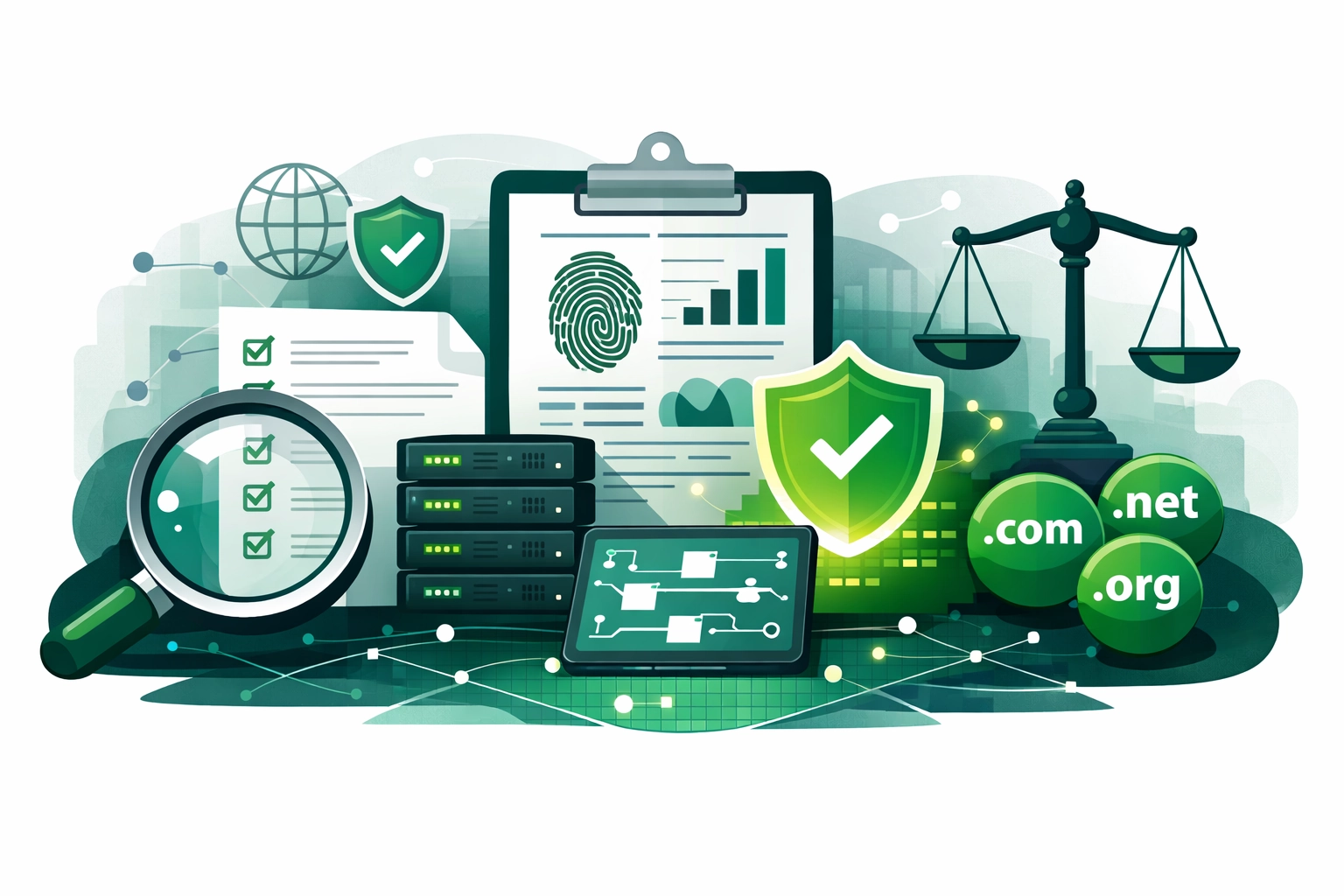
- Domain Documentation Ledger: establish a centralized ledger that captures essential attributes for each domain (registrar, ownership, expiry, DNS records, subdomains, related brand assets, and incident history). This ledger becomes the authoritative source of truth for domain-related risk analysis and incident response.
- Data points to capture: domain name, TLD, registrar, registrant organization, administrative contact, expiry date, DNSSEC status, DNS records, linked subdomains, partner domains, and any security controls in place (e.g., TLS certificates, DMARC/SPF/DKIM settings).
- Evidence trail: attach or reference audit trails, renewal notices, change logs, and incident reports. This supports regulatory readiness and post-incident forensics.
- Data sources: combine internal inventories with public registries, and where appropriate, integrate RDAP/WHOIS signals and other threat intelligence feeds to track changes and potential impersonation attempts.
The ledger is more than a static list; it’s the backbone of risk analytics. By normalizing domain data into a consistent schema, teams can run cross-domain queries, identify gaps, and demonstrate maturity in governance during audits. For readers implementing this, reference materials and data services such as those available on BPDomain’s platform can help assemble and harmonize domain records across multiple TLDs and geographies. BPDomain Link Portfolio offers a practical anchor for understanding how a centralized domain ledger can be anchored to real-world assets. List of domains by TLDs and RDAP & WHOIS Database illustrate how data streams feed into governance.
Layer 3 — Risk Scoring and Continuous Monitoring
Translate ledger data into a formal risk posture. A pragmatic scoring model recognizes multiple risk dimensions, weighting them to reflect business priorities:
- Brand risk — impersonation, phishing risks, and brand dilution across markets.
- Security risk — exposure stemming from misconfigurations, subdomain risk, weak TLS, or unmanaged third-party hosting.
- Compliance risk — regulatory exposure related to data residency, privacy, and cross-border asset management.
- Operational risk — renewal gaps, registrar lockouts, or governance handoff failures.
One practical approach is a 0–5 scale per dimension, with a weighted aggregate score that maps to “Watch,” “Review,” or “Mitigate” actions. The CMS and NIST guidance emphasize building a coherent risk management program around continuous monitoring, cross-functional oversight, and explicit governance. Regularly update risk scores as domains are added, retired, or reconfigured in response to business changes. The result is a living risk dashboard that ties digital assets to enterprise risk appetite. (security.cms.gov)
Layer 4 — Incident Response, Recovery, and Lifecycle Hygiene
Domain-related incidents can be time- and reputation-sensitive. A documented lifecycle and an explicit response playbook reduce mean time to containment and recovery. Core capabilities include:
- Incident playbooks: predefined steps for URL impersonations, DNS changes, or certificate misconfigurations, including communications templates for internal and external stakeholders.
- Offboarding and decommissioning: a risk-informed end-of-life process for domains that are no longer needed, with evidence of secure sunset steps and partner notifications.
- Audit trails and compliance artifacts: retention policies for historical domain records, DNS changes, and incident reports to satisfy regulatory and board-level inquiries.
In practice, a robust domain incident framework aligns with broader enterprise incident response capabilities, ensuring that domain events are not treated as isolated IT nuisances but as signals with operational and reputational impact. Industry guidance emphasizes the need to integrate SCRM into the enterprise response and continuity planning, rather than handling it as a purely technical matter. (cisa.gov)
Putting the Pieces Together: A Practical Implementation Roadmap
Below is a pragmatic, eight-step plan to operationalize domain portfolio governance within ERM. It is designed to be implementable in mid-market to large-enterprise contexts without requiring a full organizational overhaul.
- Map ownership and footholds: assemble a cross-functional governance team and define domain ownership for every asset. Begin with a pilot domain set (e.g., business-critical brands) and expand after learning lessons.
- Launch the Domain Documentation Ledger: adopt a standardized schema and fill in core fields for all assets. Start with a minimal viable dataset, then enrich over time with DNS records, certificates, and incident histories.
- Align with ERM taxonomy: tie each domain to enterprise risk categories (brand, cyber, compliance, operations) and assign initial risk scores.
- Institute continuous monitoring: deploy renewal alerts, registrar-change notifications, and basic threat intel feeds to surface early warning signals.
- Integrate with vendor risk management: ensure domains used by suppliers, partners, or contractors enter VRM processes and are monitored for changes that could affect third-party risk.
- Develop incident response playbooks: codify actions for impersonation, DNS hijacking, and TLS misconfigurations; specify stakeholder notification and escalation paths.
- Set governance metrics and dashboards: track renewal timeliness, incident frequency, and risk score trends; report to the enterprise risk committee on a quarterly basis.
- Scale and mature: expand the ledger, integrate with more data sources (e.g., WHOIS security notifications, subdomain inventories), and refine the risk model as business needs evolve.
For organizations seeking a practical way to jumpstart this work, the BPDomain portfolio tooling demonstrates how a centralized brokerage of domain data can support governance across TLDs and geographies. The ability to download and view domains by TLD (for instance, .link, .tv, or .pt) is part of a broader strategy to standardize portfolio views and enable cross-border risk analysis. See BPDomain’s resource pages for context: BPDomain Link Portfolio, List of domains by TLDs, and RDAP & WHOIS Database for data provenance and traceability.
Expert Insight and Common Pitfalls
Industry practitioners consistently highlight a few truths when integrating domain portfolios into ERM. First, a domain inventory must be treated as dynamic, not static. Domains expire, move between registrars, and can be repurposed by new business units. The most successful programs establish automated data feeds and a governance cadence that reflects business tempo, not just IT cycles. Second, the risk model must accommodate domain-specific dynamics—brand impersonation risk, misissued certificates, and subdomain sprawl require tailored scoring and response playbooks. Third, be mindful of common missteps: treating domain management as a back-office IT task, failing to align with privacy and cross-border data regulations, and neglecting subdomains and partner domains. These oversights undermine the broader ERM posture and can impair incident response. In short, the most effective programs treat domain governance as a core risk control, not as a supplementary compliance activity.
Expert guidance from risk and security communities supports this approach: cross-functional governance, continuous monitoring, and policy-aligned documentation are central to a resilient risk posture. However, every program has limitations, and the most common pitfall is underestimating the complexity of global brand portfolios—especially when operating across multiple jurisdictions with differing privacy and consumer-protection regimes. This reality necessitates a deliberate, staged rollout with clear documentation standards and governance handoffs. (gartner.com)
Limitations and Common Mistakes to Avoid
Even well-intentioned programs can stumble. Here are the most frequent limitations and how to avoid them:
- Over-segmentation: treating domains in silos by business unit rather than as an enterprise asset leads to duplications and blind spots. A consolidated ledger with federated inputs is preferable.
- Inadequate data quality: incomplete fields, missing expiry data, or inconsistent ownership records erode trust in the ledger and delay decisions. Establish mandatory fields and validation checks during data entry.
- Neglecting subdomain portfolios: focused only on primary domains while subdomains drift, creating impersonation risk and governance gaps. Include subdomains and partner-hosted assets in the risk model.
- Reliance on a single data source: relying solely on RDAP/WHOIS without corroborating data can miss changes and misattribute risk. Diversify data sources and cross-validate entries.
- Onboarding friction with vendors: failing to integrate domain governance into vendor risk management can miss critical exposure. Make domain-informed onboarding a standard VRM requirement.
Incorporating these lessons into the ERM framework improves resilience and auditability. It also helps ensure that domain governance remains proportionate to risk, rather than becoming an overbuilt, underutilized process. For readers seeking practical data-generation and governance capabilities, BPDomain’s platform can help streamline data capture across domains and TLDs, providing a platform-neutral model for centralizing domain documentation and governance.
Where Domain Documentation Fits in the Broader Brand-Security Landscape
Domain documentation is not a standalone artifact; it is a nervous system for enterprise brand protection. It connects brand governance, security controls, regulatory compliance, and incident response. The linkage to ERM is not merely theoretical—risk professionals increasingly expect domain data to be mapped to risk registers, internal controls, and assurance activities. The current governance discourse emphasizes automated data collection, transparent lineage, and auditable decision trails. This aligns with both CMS’s emphasis on third-party risk management and NIST’s guidance on cyber SCRM as a core organizational capability. (security.cms.gov)
Case Perspective: How a Real-World Enterprise Might Begin
Imagine a multinational consumer brand that operates in five regions, each with several regional domains and third-party partners hosting co-branded pages. The company initiates a domain governance program anchored in ERM. The cross-functional team inventories the global domain set, consolidates ownership, and introduces the Domain Documentation Ledger with core fields. They map each domain to risk categories, set initial scores, and establish renewal reminders tied to procurement SLAs. Over six quarters, they expand the ledger to include subdomains, partner domains, and a live dashboard for the risk committee. The result is a simpler audit trail for brand protection, reduced impersonation risk, and a demonstrable improvement in resilience against domain-related disruptions. While this is a hypothetical scenario, it captures the essential steps that many organizations adopt when domain portfolios become a critical control in enterprise risk management.
Conclusion: Turning Domain Portfolios into a Strategic Asset
Domain portfolios are more than a catalog of registrations; they are a critical control point in enterprise risk management. By treating domain assets as strategic governance items, organizations can improve brand protection, reduce impersonation risk, and strengthen supplier risk management. The key is to couple robust documentation with cross-functional governance, dynamic risk scoring, and well-rehearsed incident response. In short, the discipline of domain documentation—bolstered by integrated ERM practices—transforms digital assets from a potential source of disruption into a measurable, auditable pillar of enterprise resilience.