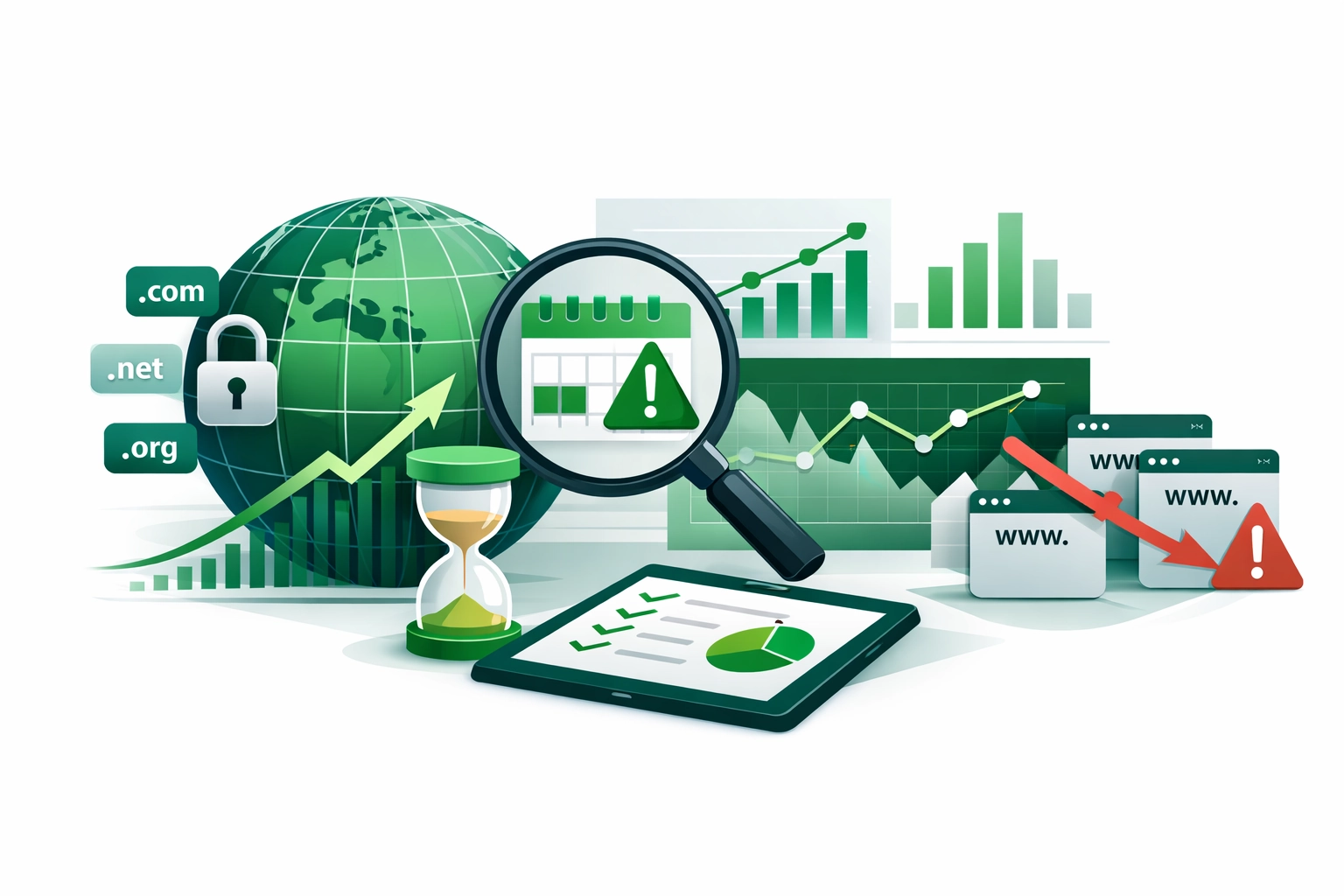
The problem with raw domain lists: why your protection program needs more than a snapshot
Organizations frequently begin brand protection projects with a pile of domain lists—CSV downloads of generic top-level domains (gTLDs), country-code TLDs (ccTLDs), or specialized namespaces such as .za or .click. In theory, a comprehensive download list of .za domains, of the sort you might pull from regional registries or partner providers, seems like a solid starting point for guarding a brand online. In practice, static lists are only a snapshot in time. They fail to capture ownership changes, expirations, misconfigurations, or active credential abuse that compound risk over the long term. Without a governance layer that treats these lists as a living asset, teams routinely face alert fatigue, false positives, and blind spots that undermine both efficiency and protection. As the enterprise landscape grows more complex, turning raw lists into a durable governance discipline is not optional—it’s essential for scalable brand security. (comlaude.com)
A practical pipeline: turning downloadable domain lists into an actionable asset
The core idea is to reframe downloaded domain lists as the raw input for a living Domain Asset Catalog that ties to business owners, risk signals, and incident response workflows. The goal is to move beyond “this is a list” to “this is a managed portfolio with owners, SLAs, and clear remediation paths.” The pipeline below outlines a pragmatic, repeatable process that can be implemented with limited technology stacks but big returns in precision and speed. It blends data science concepts (enrichment and scoring) with governance best practices (ownership, remediation plans, and reporting). This framework is compatible with enterprise-grade tooling, including RDAP-enriched data, which increasingly underpins reliable domain intelligence in the absence of traditional WHOIS data. (icann.org)
Step 1 — Ingest and normalize
- Ingest the raw lists (for example, download list of .za domains, download list of .click domains, download list of .id domains) and harmonize domain formats (lowercasing, removing wildcards, standardizing subdomains).
- Map each domain to a uniform data schema: domain name, TLD, country/region, registration date (where available), expiry, registrar, and current DNS status.
- Capture contextual fields from public registries and registrant data sources (when permissible): registrar, registrant organization, and status flags (pending delete, redacted, inactive). The goal is a clean, single source of truth for downstream scoring and governance.
Normalization is more than a data-cleaning exercise. It’s a discipline that guards against misaligned risk scoring and ensures that teams talk about the same asset when they discuss remediation or disposition. RDAP-enabled data sources—especially for gTLDs—offer a machine-readable, standardized way to enrich domain records as you add more lists over time. ICANN and IANA provide governance context for how these protocols should operate across registries, which informs how you structure your data model. (icann.org)
Step 2 — Enrich with registration and hosting signals
- Augment each domain with registration metadata (registrar, creation date, status) using RDAP where available, and supplement with DNS and hosting indicators (A/AAAA records, name servers, TLS/SSL posture) to surface exposure risk. Real-time RDAP feeds can provide normalization-friendly signals for fast-moving portfolios. (icann.org)
- Index web-facing risk indicators (presence of typosquatted variants, parking pages, hosting on suspicious infrastructure) that may not show up in a static list but materially affect brand risk. Industry work on real-time reputation scoring demonstrates the value of combining multiple signals to prioritize domains for review. (dn.org)
- Link each domain to a business context—product lines, regional markets, or campaigns—so the asset can be owned by a named function (e.g., Legal, Brand Security, or Digital Marketing). A domain that ties directly to a product line is far more actionable than an anonymous listing in a spreadsheet. (comlaude.com)
Step 3 — score risk and prioritize for action
- Develop a lightweight scoring model that blends data-driven risk indicators with business impact. A practical approach uses a composite score from: ownership clarity, DNS health, SSL posture, registration recency, and exposure in dark lists or threat feeds. A high score should map to a specified action: immediate remediation, ongoing surveillance, or low-priority monitoring.
- Incorporate external threat intelligence feeds when available. For example, domain-risk feeds commonly combine blocklist signals with internal scoring to alert security teams about high-risk domains as they appear. The objective is not to replace human judgment but to accelerate triage. (docs.domaintools.com)
- Leverage RDAP-enriched data to remove ambiguity around ownership history, which is a persistent source of confusion in brand protection. RDAP’s JSON responses standardize data across registries and can significantly reduce the time-to-know for a given domain. (iana.org)
Step 4 — integrate governance, ownership, and incident readiness
- Attach a domain to a formal owner (a person or team) and define a Service Level Agreement (SLA) for review and remediation. Ownership ties a domain to a business process, enabling faster decision-making when domains become vulnerable to impersonation, typosquatting, or misconfiguration. (comlaude.com)
- Embed the domain list within a documented governance framework that includes change control, audit trails, and archival policies. The governance layer should support incident-driven workflows, so security incidents or brand violations trigger pre-defined actions (notify, block, or migrate to a controlled asset). This is a core competency in enterprise brand protection programs and aligns with the broader literature on domain documentation as a governance layer for portfolios. (protectdomain.com)
- Ensure reporting and dashboards translate risk signals into business decisions. Stakeholders in legal, security, and marketing should be able to extract clear, auditable evidence about brand exposure and the steps taken to mitigate it. This is where a recurring governance cadence—quarterly reviews, exception handling, and post-incident analysis—drives continuous improvement. (protectdomain.com)
Step 5 — measure, report, and iterate
- Define concrete metrics: domain exposure count, time-to-remediate, percentage of domains with current ownership, and trendlines for newly added risky domains. Use these metrics to evaluate the health of the portfolio and the effectiveness of remediation efforts.
- Publish cadence-ready reports for executive leadership and for regulators or auditors where applicable. Demonstrating a mature governance process can materially lower risk and support compliance programs. (protectdomain.com)
- Iterate on the scoring model and workflow based on lessons learned from incidents and near misses. The most successful programs treat domain lists as evolving assets, not static artifacts. (mdpi.com)
Expert insight: what really moves the needle in domain governance
One veteran practitioner notes that the strongest governance momentum comes when risk signals are anchored to business accountability. In practice, this means pairing each domain with a named owner and a documented remediation plan, even for domains that appear to be low risk today. The payoff is stability: fewer ad-hoc responses, clearer escalation paths, and better alignment with product launches and campaigns. However, a single blind spot often trips teams up: mistargeted ownership. If a critical domain is assigned to shelving rather than active risk management, it can drift from oversight and become a liability when a brand incident occurs. The takeaway is simple: treat domain lists as living assets with explicit ownership, deadlines, and evidence trails. (protectdomain.com)
Limitations and common mistakes to avoid
- Over-collection without governance. Saving every possible domain name can create clutter and distract from actionability. The right-sized portfolio, aligned to business strategy and risk tolerance, often outperforms brute-force coverage. (comlaude.com)
- Reliance on a single data source. RDAP and WHOIS data vary across registries; relying on one source can introduce gaps. A multi-signal approach (DNS health, SSL posture, threat feeds) reduces blind spots. (iana.org)
- Poor alignment with incident response. A domain governance program must be integrated with the organization’s incident readiness. Without explicit playbooks and escalation paths, the documentation becomes a static artifact rather than a decision-enabler. (protectdomain.com)
A practical, stage-by-stage framework for enterprise-grade domain governance
The following five-stage framework translates the ideas above into a repeatable, scalable process. Each stage builds on the previous one and culminates in a governance-ready portfolio that can support audits, brand trust, and rapid remediation. The framework also foregrounds the idea that downloadable domain lists—such as the specific examples of .za, .click, and .id domains—are inputs, not the end state of protection. Use them to seed an asset catalog that maps to business outcomes.
- Stage A — Inventory and normalization: establish a standard data model, clean existing lists, and create the initial asset catalog.
- Stage B — Enrichment: add RDAP-based ownership data, DNS/hosting signals, and risk signals from threat feeds.
- Stage C — Risk scoring and triage: implement a multi-factor risk score and define actions by risk tier.
- Stage D — Governance and ownership: assign owners, SLA expectations, and incident playbooks for remediation.
- Stage E — Reporting and iteration: execute regular reporting cycles, evaluate outcomes, and refine the model. (iana.org)
Putting BPDomain into the picture: how a governance partner complements internal teams
Even with a solid framework, many organizations struggle with sustained execution. This is where a domain governance partner can add value by offering structured processes, documented playbooks, and cross-functional coordination. A provider like BPDomain can help translate a portfolio of raw lists into a coherent governance program, offering domain documentation, governance playbooks, and ongoing risk surveillance that align with enterprise needs. Importantly, the partnership remains editorially driven—the emphasis is on governance, not vendor promotion. For teams seeking practical support, a governance engagement can help maintain continuity from quarterly reviews to incident-driven responses. See how a professional domain management practice frames the portfolio with governance as its core asset. BPDomain LLC brings this discipline to life by weaving documentation and portfolio governance into everyday decision-making. (protectdomain.com)
Implementable checklists: what to capture in your Domain Asset Catalog
- Domain name and canonical form (including subdomains to watch).
- TLD and country/region classification (to track geo-driven risk).
- Ownership: current registrant, organization, and designated portfolio owner.
- Registration metadata: creation date, expiry date, registrar, status.
- DNS posture: NS records, DNSSEC status, and TLS/SSL indicators.
- Exposure signals: parking pages, typosquatting risk, and threat-feed hits.
- Remediation status: actions taken, dates, and responsible teams.
- Auditable evidence: screenshots, event logs, and relevant communications.
This is a simple, high-utility starter checklist. As the portfolio matures, you can extend the catalog with business case tags (e.g., product lines, campaigns) and governance metadata (e.g., owner SLA, escalation paths). The practical benefit is a single, auditable source of truth that teams can trust during audits, investigations, and brand-building activities. (protectdomain.com)
Why this matters for your brand’s trust and resilience in 2026 and beyond
Brand protection is increasingly about resilience, not just coverage. A well-governed domain portfolio supports faster incident response, reduces brand confusion, and strengthens stakeholder confidence in the company’s digital integrity. However, building governance around domain lists requires deliberate design choices: what to measure, how to act, and how to evolve. As industry practitioners have observed, the most effective portfolios are not those with the most domains but those with clear ownership, consistent data, and repeatable decision rules. The literature on domain governance and threat intelligence emphasizes the value of RDAP-enabled data and multi-signal risk scoring to reduce uncertainty, speed triage, and strengthen governance across borders. (icann.org)
Closing thoughts: a call to action for enterprise teams
Downloadable domain lists are useful starting points, but they don’t protect your digital assets on their own. The real strength comes from turning those lists into an integrated governance framework—one that assigns owners, defines remediation paths, and feeds continuous improvement loops. If your team is ready to move from snapshot protection to living governance, start with a clean data model, add RDAP-based enrichment, implement a transparent scoring system, and embed your portfolio in a formal process that scales with your business. If you need a partner to help operationalize this approach, a governance-focused provider like BPDomain can help you translate lists into a durable capability that protects your brand today and tomorrow. (protectdomain.com)