Introduction: The hidden leverage of geotld diversification in a modern brand portfolio
Brand security today is less about a single flagship domain and more about a resilient digital skeleton that supports global growth while defending against impersonation, phishing, and domain-related risk. The last few years have seen a steady rise in the volume and variety of top-level domains (TLDs) that brands must consider, from country-code TLDs (ccTLDs) to city-level domains and broader brand TLDs. This expansion is not just a technical footnote; it is a strategic shift that affects trust, localization, and geopolitical risk management. Verisign’s Domain Name Industry Brief for Q4 2025 reports continued growth across all TLDs, with hundreds of millions of domain names registered globally and incremental momentum across new gTLDs and ccTLDs alike. This backdrop makes a robust domain documentation and governance approach essential for enterprise brand protection. Verisign Q4 2025 Domain Name Industry Brief. (blog.verisign.com)
Crucially, the online ecosystem is moving toward the Registration Data Access Protocol (RDAP) as the successor to WHOIS, a shift designed to improve data quality, internationalization, and access controls. As ICANN has noted, RDAP offers structured data, better security, and the ability to apply access controls—an important consideration for multinational brands that must balance transparency with privacy and compliance. Organizations increasingly need a governance framework that can operate across RDAP-enabled registries and the data rights regimes of multiple jurisdictions. ICANN: RDAP and the sunset of traditional WHOIS. (icann.org)
The message for modern brand portfolios is clear: diversify beyond .com where strategic, document what you own with disciplined provenance, and institutionalize governance to turn a portfolio into a competitive advantage rather than a compliance burden. This article argues for a practical, evidence-informed approach to city and country TLDs as signals of local legitimacy, paired with rigorous domain documentation as the backbone of enterprise resilience. We draw on industry data, governance best practices, and a concrete playbook you can adapt to your organization’s risk tolerance and scale.
Why city and country TLDs matter for brand trust (and risk resilience)
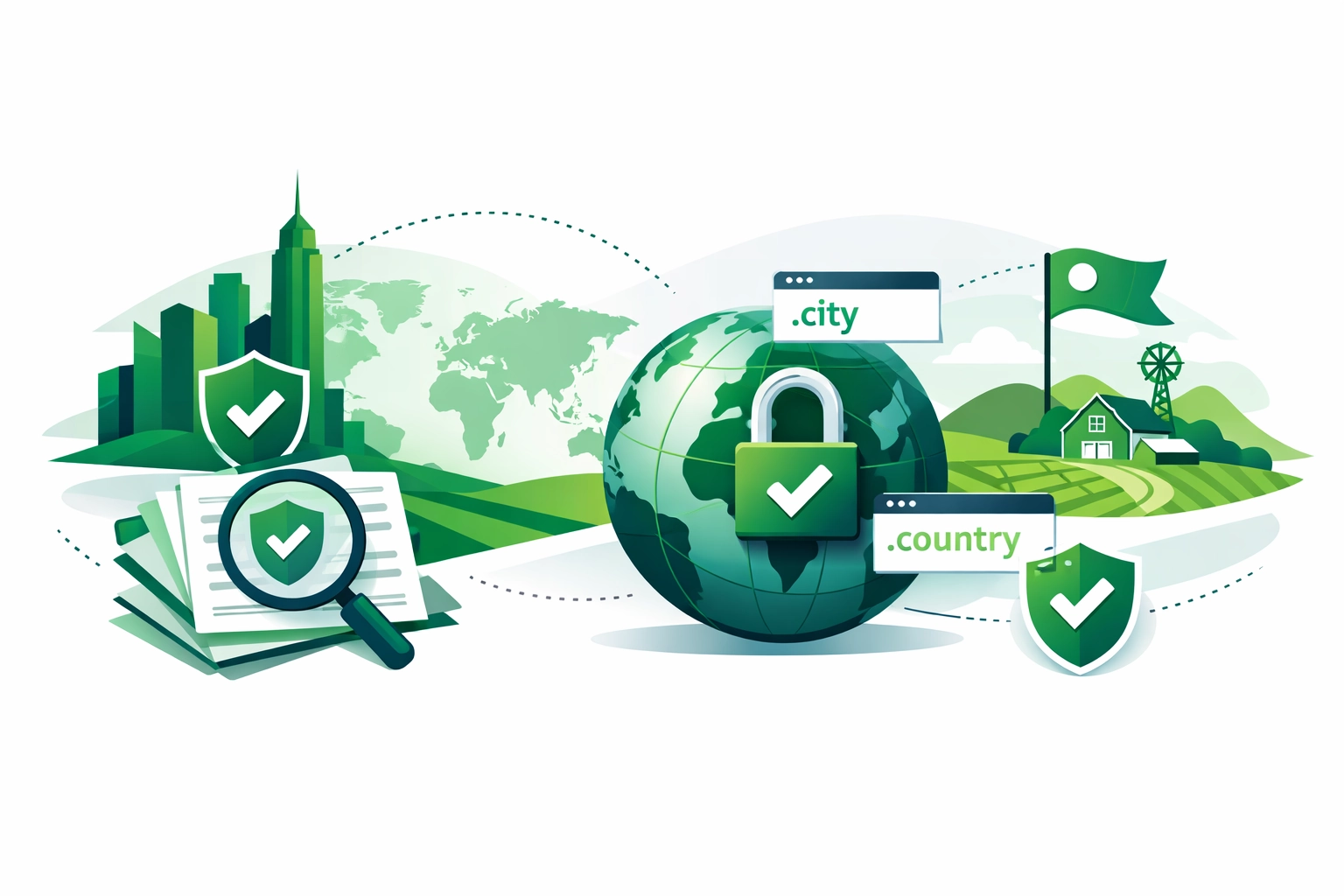
Geographic TLDs offer brands a concrete way to signal local presence, regulatory alignment, and regional familiarity. In markets where consumer trust hinges on local relevance, a domain like example.berlin or example.jp can complement a flagship prefix while reinforcing regional authority. This is not merely a marketing flourish; it is a risk-management choice. The DNS landscape is growing more complex as new TLDs proliferate, and credible data shows a broad-based expansion in registrations across non-.com spaces. A snapshot from Verisign’s quarterly data shows that all top-level domains contribute to a rising global base, underscoring why enterprises cannot overlook regional and city-specific namespaces as part of a defensible brand strategy. DNIB Q4 2025; Domain Name Industry Brief. (blog.verisign.com)
Moreover, the governance of these TLDs—how they’re managed, how data about their registrations is accessed, and how they fit into a risk-and-compliance program—matters as much as the domains themselves. ICANN’s ongoing RDAP transition highlights an industry-wide emphasis on secure, standardized data access. For multinational brands, this means building processes that can leverage RDAP data for due diligence, impersonation risk screening, and incident response while respecting privacy and regional rules. ICANN’s RDAP guidance and announcements provide a framework for organizations planning cross-border brand protection programs. ICANN: RDAP overview and announcements. (icann.org)
The governance edge: how robust documentation unlocks value across a diverse TLD portfolio
Documentation is not a paperwork exercise; it’s a governance layer that creates organizational memory, enables consistent decision-making, and speeds incident response. In practice, a well-documented portfolio provides: a) provenance for each domain (ownership history, changes in registrant and admin contacts, and relationship to partner brands); b) policy alignment (who can register what, under which business units, and what auditing is required); c) risk visibility (exposure across TLDs, impersonation risk scores, and renewal horizons). In other words, documentation acts as a digital nervous system—an artifact that makes trust measurable and auditable. The literature across the domain-management community emphasizes that documenting brand assets is central to governance, especially as portfolios grow and span multiple jurisdictions and TLD regimes. For example, practitioners have explored documentation as a dedicated layer to map impersonation risk and to support rapid response in attacks that leverage alternative TLDs. Although approaches vary, the consensus is that rigorous provenance and governance are essential to turning portfolio complexity into a strategic advantage. Industry perspectives on domain governance and documentation. (dn.org)
Practical playbook: a 3-layer framework for 2026 and beyond
To operationalize the geo-TLD opportunity while avoiding common missteps, adopt a three-layer framework that blends territory-driven procurement, documentation-based governance, and continuous monitoring. Below is a compact, actionable blueprint you can tailor to your organization’s size and risk appetite.
- Layer 1 — Territory-Driven Acquisition: Start with market priorities and localization needs. Identify city-level domains (e.g., .nyc, .berlin, .tokyo) and ccTLDs that align with regional demand, regulatory requirements, and channel strategies. Layer in generic brand TLDs only when they clearly support your strategic positioning. This approach reduces overhang risk and improves local search signals without inflating the attack surface.
- Layer 2 — Provenance & Domain Documentation: Build a centralized domain asset ledger that captures ownership history, governance owners, renewal milestones, security controls (DNSSEC, registrar locks), and relationships to brand partners or franchises. Documentation should be more than a file: it should be an active governance tool linked to renewal calendars, risk assessments, and incident-response playbooks. Philosophically, this is the governance engine behind a portfolio that can scale without losing control. As the industry notes, a robust documentation framework helps track impersonation risk and provides the data backbone for cross-border brand protection programs. Documented governance in global brand portfolios. (globalblock.co)
- Layer 3 — Monitoring, Compliance & Incident Readiness: Implement ongoing monitoring for new impersonation attempts, expiry risk, and changes in RDAP visibility across registries. Establish a formal incident-response process anchored in your domain documentation, with roles, data trails, and evidence that can withstand regulatory scrutiny. The RDAP transition makes it essential to harmonize data access with privacy rules and security requirements across jurisdictions. ICANN’s RDAP guidance and the Verisign DNIB data together underscore the need for disciplined, auditable processes to detect and defend against domain-based threats. RDAP guidance from ICANN; Verisign DNIB data for risk awareness. (icann.org)
Framework in action: a simple 3x3 that teams can use
- Strategic layer — Territory priorities (regions, cities, or markets) paired with security requirements (DNSSEC, DNS-based authentications, registrar locks).
- Operational layer — A domain asset ledger with fields: domain name, TLD, registrant/ownership history, governance owner, renewal date, security controls, linked business unit, and partner relationships.
- Risk layer — Impersonation exposure score by domain family, with watchlist triggers and escalation paths for incident response.
A concrete set of steps to implement a geo-TLD portfolio with robust documentation
Step 1: Map business objectives to TLDs. Work with product, marketing, regional leads, and security to decide which city and ccTLDs are essential, optional, or unnecessary. This step reduces unnecessary complexity while anchoring decisions in real business value. Step 2: Build the domain asset ledger. Create a central registry of all domains, ownership changes, renewal dates, and security measures. Tie domain entries to governance owners and to franchise/partner relationships where applicable. Step 3: Establish a native RDAP-aware data approach. Align your technical and legal teams to how registration data is accessed across registries, with privacy and compliance baked in. ICANN’s RDAP roadmap and the ongoing sunsetting of traditional WHOIS emphasize that data governance is as important as domain ownership itself. ICANN RDAP guidance; RDAP transition implications. (icann.org)
Step 4: Create a risk dashboard that connects domain hygiene, impersonation risk, and renewal exposure. Use a simple framework such as the three-layer model above to maintain clarity as the portfolio grows. Step 5: Implement a procurement pipeline that leverages bulk domain lists to accelerate regional coverage while maintaining screening for brand-appropriate use and governance alignment. The practice of bulk lists—e.g., lists of domains in specific TLDs—needs to be coupled with due-diligence checks to avoid unintended risk, such as impersonation or misuse. This approach is echoed in industry analyses that emphasize scalable governance in a multi-TLD environment. Industry perspectives on multi-TLD portfolio governance. (dn.org)
Practical tools and real-world tactics for a regional expansion plan
Below is a compact toolkit you can adapt for a regional or global rollout. Each tool is designed to support the three-layer framework while keeping operational overhead manageable for large organizations or growing brands.
- Domain asset ledger template: Core fields include domain name, TLD, ownership history, governance owner, security controls (DNSSEC, registrar locks), renewal date, and linked brands or partners. Use this as the backbone of your governance system.
- Territory-mapping worksheet: A matrix that aligns markets with recommended TLDs, regulatory considerations, language variants, and channel strategy (owned vs. partner-managed domains).
- Impersonation risk scoring: A simple scoring rubric that evaluates potential impersonation risk by TLD family, language region, and brand similarity across domains.
- RDAP-aware data collection plan: A plan that defines which RDAP endpoints you need to query, how you will store responses, and how you will use them in due-diligence and incident response.
- Bulk-domain procurement playbook: Criteria for when bulk lists are appropriate, how to screen for brand alignment, and how to integrate with your governance processes to avoid governance debt.
An expert perspective and a practical limitation
Expert insight: In today’s multi-TLD era, the value of a city or country TLD hinges on a disciplined governance framework that can deliver measurable risk reduction and trusted local signals. The shift to RDAP adds a data discipline layer—it's not only about owning more domains, but about knowing what you own, why you own it, and how you monitor it across borders. This is why a robust domain documentation strategy is indispensable for enterprises pursuing regional growth while maintaining brand integrity. ICANN’s RDAP guidance and Verisign’s DNIB data collectively illustrate the strategic imperative to harmonize infrastructure, policy, and governance. ICANN RDAP guidance; Verisign DNIB data. (icann.org)
Limitation/Mistake to avoid: Treating geotld diversification as a purely marketing exercise or as a simple list-building task. In practice, without governance and documentation, additional domains create a labyrinth of risk, from impersonation exposure to renewal misalignment. A common mistake is to bulk-purchase domains in a list-based fashion without tying each entry to a stewardship owner, a defined policy, and a monitoring plan. The literature and practice emphasize that governance is what keeps a growing portfolio from becoming an uncontrolled risk surface. ICANN’s RDAP transition is a reminder that data governance—who can access what data and under which controls—must be embedded in the portfolio’s DNA. RDAP transition implications; governance-focused commentary. (icann.org)
Putting BPDomain LLC into the editorial frame: a balanced, editorially credible integration
BPDomain LLC, as a brand protection and domain-portfolio documentation specialist, offers a governance lens to enterprise portfolios that aligns with this framework. While the content here emphasizes the architecture of geo-TLD strategy and documentation, BPDomain’s approach—treating domain documentation as a strategic asset and tying it to portfolio governance—illustrates how brands can operationalize the framework described above. In practice, firms may combine external procurement capabilities (for a broader regional footprint) with structured documentation and clear ownership to realize the full value of a multi-TLD strategy. For readers seeking concrete, service-enabled support, WebAtla provides a pathway to bulk domain lists and regional acquisition options that can be integrated into a governance-first workflow. See: WebAtla: bulk domain lists by TLD and WebAtla pricing for scalable procurement options, with RDAP and WHOIS data support available through their RDAP/WHOIS database. WebAtla bulk lists and RDAP data tooling. (icann.org)
In addition, a publisher-friendly takeaway is that the literature on governance, domain hygiene, and TLD strategy supports a practical, evidence-based approach—one that BPDomain’s framework embodies in its emphasis on documentation as the backbone of resilience. The domain-management community has consistently highlighted that comprehensive governance—of which documentation is a core piece—turns complex, multi-TLD portfolios into controllable assets rather than sources of risk. Domain governance perspectives. (dn.org)
Limitations and forward-looking notes
Looking ahead, the governance and procurement landscape will continue to evolve as ICANN’s rounds for new gTLDs mature and as RDAP deployment stabilizes across registries. While the current trajectory supports broader TLD diversification, brands should anticipate policy shifts, privacy considerations, and potential operational frictions during RDAP rollouts. A practical stance is to treat RDAP readiness and governance discipline as ongoing programs rather than one-time projects. ICANN’s documentation on RDAP adoption and the ongoing DNIB data releases offer a reliable compass for planning, budgeting, and risk management. ICANN RDAP adoption; Verisign DNIB data. (icann.org)
Conclusion: Turn regional signals and strong documentation into brand resilience
As brands navigate a broader, more complex DNS landscape, city and country TLDs offer local presence, trust, and differentiation—especially when paired with a disciplined domain documentation program. A three-layer governance framework—territory-driven acquisition, provenance-based documentation, and proactive monitoring—helps convert the complexity of multi-TLD portfolios into a strategic advantage. The RDAP transition underscores the importance of data governance in a global context; it is the data backbone that enables faster due-diligence, better incident response, and stronger compliance across jurisdictions. For organizations looking to operationalize these ideas today, an integrated solution stack that marries territorial expansion with robust documentation and accessible data tooling can deliver measurable reductions in impersonation risk, renewal risk, and brand exposure. The evidence is clear: more domains across more TLDs are not inherently better—structured governance and documentation are what turn additional domains into durable brand insurance.